Friday, October 23, 2009

Its an Essay... Right?

The following is a response to the question 3 proposed by the NCT learning blog,

_________________________________________________________________________________________________

Digital media put the tools of production into the hands of the everyday computer user making it incredibly easy to produce content. These creative skills used to be something that people worked to develop. Now it appears that amateurs can produce content of a fair standard within a relatively short period of time. Where does this leave 'professionals' and highly-skilled artists? Choose one area of creativity and discuss some of the challenges facing practitioners vs amateurs in producing digitalcontent.

______________________________________________________________________________________________

Digital Music Production Technology in the Digital Age


Due to the massive influx of interest and mass marketing of digital technology, digital music production has never been so easy to create. With the constant development of digital studios, legal and illegal means of obtaining new industry standard audio technologies and instruments, and the rising popularity of online music distribution stores, the distinction between practioner and amateur in the facet of digital music production, has never been so severely blurred. However, fair distinctions can still be made, and in some cases, explicitly highlighted by the technologic advances to which aim in assisting and reducing the complexity of digital music production. Perhaps, it is not the distinction between professional and amateur that has been blurred, but the gap between the two merely shortened. With the rise in popularity of digital music production, coupled with the large influx in online hosting websites, blog spots and other various online resources aimed at sharing industry quality virtual audio technologies and instruments, tools which were at one time, only available to established producers and or enthusiasts with enough disposable cash, are now available to your everyday computer user; for next to nothing. The shift from the once conventional method of buying music from a store, to buying music online, has seen a large development and increase in websites offering high quality digital music, direct to the user, online. Distribution of digital music has never been so simple. It is due to these various factors, that the seeming degradation of the classification between professional and amateur in digital music producer has occurred.

Digital music production technology has developed in such a way, that if you own a personal computer, and or laptop, you can have a professional fully functional and mobile studio workstation. The ability to compose, record, edit, mix and remix is all available given the development of virtual workshops and multi-trackers, more or less, identical to the real life studio workshops that cost thousands to create. (Pekka G, Ilpo S. 1999, pg 223) By the mid 1980’s, the typical professional studio generally comprised little more than a 16 or 24 track tape machine, 24 track mixing desk, sufficient rack of signals, processors and effects, as well as, half a dozen analogue synths. From an early stage, the advantages of having a digital assisted recording studio were already being noted. (Middleton, C 2006, pg 20) The massive recording studios of today, despite now containing a far greater range of equipments, have found their way onto the everyday computer. Studios that were once basically off limits to professional artists only, costing hundreds of dollars a day to use, are now fully available in a virtual environment. (Journal of Digital Recording and Reproducing Techniques, pp. 48 – 55) With the huge potential of these virtual workshop environments realized, big company investments along with the mass marketing of this digital technology resulted in professional studio quality programs, aimed at taking the complexity out of the recording process. This, in a sense, has leveled the playing field for all artists, regardless of their musical abilities.

The development of these digital workstations essentially, eliminated the need for the user to understand the theory behind the given tools of production (be it a compressor, equalizer or type of effects). (Middleton, C 2006, pg 37 - 43) Users have the ability to select from pre-designed setups for each individual tool, as created by the software designers. (Middleton, C 2006, pg 40) This allows even those users with limited to no knowledge of track dynamics to produce a seemingly polished sound. ((Middleton, C 2006, pg 26) However, this assistance in turn creates a fundamental flaw in the development of user’s future tracks. Professionals on the other hand, with the ability and understanding behind a tracks design, structure and dynamics, will be able to produce sounds at a higher quality than that of the standard of a generic ‘to suit all sounds’ setup for given equalizers, compressors and other tools created by the software makers. The challenges of dithering, effects, equalization, mastering, mixing, normalization and quantization can all be solved from a novices point of view, using the software settings, however, a professional can utilized the theory behind the tools to produce a higher quality track in the end. This therefore shows, that whilst the development of these digital workstations have allowed for nearly any user to produce a relatively high quality, the distinction between professional and amateur can still clearly be noted. However, these new digital production tools wouldn’t be in the hands of amateurs in the first place, if it wasn’t for the massive influx of interest and mass marketing of digital production technologies, coupled with a rise in popularity of blogs, forums and other internet mediums.

These days, the internet has grown to be a popular form of media, people can easily created and join worldwide community’s, specifically interested in a given hobby, to discussion and share their knowledge to a wide active audience of people. With the development of digital production technologies, and the availability of these technologies to those with access to a computer, interest in the digital music production has increased dramatically. ((Middleton, C 2006, pg 5) This increased traffic, results in more blog spots, forums and other dedicated websites aimed at sharing new digital audio technologies. With the increase in free online file hosting websites, the sharing of these files can be completed with relative ease. Whilst once upon a time, professionals would be required to purchase all their production tools, or receive products from sponsors in order to keep up to date with the latest audio technologies, at current, the latest audio technologies are hosted on websites in these given communities for anyone to obtain. Audio technology that was once only exclusive to professional artists, are now available for anyone to obtain. Distinction between practioner and amateur, in this case, comes down to the time spent learning the given virtual instrument and the actual musical theory and knowledge the producer posses. It seems that these internet communities have allowed for the connection of people in an infinite variety of ways, to share work, publish, collaborate and sell music online to a specific target audience and is even influencing the way we now purchase music material

The music industry itself is changing with the times of the internet. The selling of tracks directly to a listener online has proven to be widely popular, resulting in a large amount of online music stores popping up on the internet. The internet allows for the easy distribution of music, no matter what genre, to people all over the world. (Middleton, C 2006, pg 6 - 8) Professionals who once had to source out labels, to cover the costs of recording and distribute cds, are now able to create and distribute their own music via these online music stores. This however, is now also becoming the case for any amateur producer. Perhaps the most distinguishing factor between professional and amateur producers was distribution of music. With the change in trend of music distribution, it is now significantly easier to release new media for both parties, a large distinguishing factor in professional and amateur productions.

It is quite evident, that the developments in digital music technologies and increase internet traffic have caused a profound effect on the world of digital music production. Through the introduction of new, simplistic design digital workstations, aimed at un-complicating the production process, the increased interest and consequential sharing of digital audio technology, due to the mass marketing of these technologies, and the shift in music distribution and purchasing, the line between the definition of professional and enthusiast producers has been severely affected. However, the fundamentals of musical theory and deeper knowledge and understanding of production methods and tools, still allow for the distinguishing between the two parties involved. Whilst the range in quality of production between the two parties has been drastically reduced, there is still a notable difference between professional productions and amateur productions. Although the challenges facing both parties are seemingly similar, the extra time and money spent to develop and perfect ones production, will always separate those who have dedicated their work solely to music production, and the wider group of enthusiasts involved in the industry.

References

Kostka, Stefan M 1999, Materials and techniques of twentieth-centruy music – 2nd ed, Prentice-Hall, Inc. Upper Saddle River, New Jersey.

Pekka G, Ilpo S. 1999, An International History of the Recording Industry, Cassel, Wellington House, London.

Middleton, C 2006, Creating - Digital Music and Sound, Focal Press, Burlington, USA. Linacre House, Jordan Hill, Oxford, UK.

Zager, M 2006, Music Production: a manual for produces, composers, arrangers, and students, Scarecrow Press, Lanham, Md.

Chapman, Nigel P c2000, Digital multimedia, John Wiley & Sons, Chichester, England

Thomas S. Valpic c2000, Digital mythologies : the hidden complexities of the Internet, Rutgers University Press, New Brunswick, N.J.

‘Digital: music, recording, multimedia’, Journal of Digital Recording and Reproducing Techniques, no. 6, 1997, pp. 48 – 52

The Recording Engineer Comes of Age ‘ http://www.recordinghistory.org/ , accessed, 18/10/09


TAKE THAT WORLD! the week from hell nearing ever so closer to an end!!

Thursday, October 22, 2009

Random Car UPDATE!!!


Heres how the new rims sit... not too bad for a street car thats driven daily. (and yes i realise it needs to be lowered a few million metres.. but thats alright.. silkroad coilovers are getting ordered from JAPPPAAANNN (yee' boi') in a few weeks.. it takes about 4 - 6 weeks to get here.. so i'd say by late novemberish, i will be dragging rails on the road haha)


Installing the new r33 BMC to ensure brake pedal feel after putting on the massiffffff new brakes haha... which seem to be taken a shine to squealing quite loudly... SIGHHH... i swear to god i researched the best brake pads to buy and everyone said they were DEAD SILENT... DEAD SILENT MY ARRRSSSE haha

Monday, October 19, 2009

Slightly proud

yes i am slightly proud of my amazing photoshop skills.. i even amazed myself...

you seriously can't tell me thats not p.i.m.p?

thats riiittteee... fatlace, risky devils, NS.com reppin' hahah


Thursday, October 15, 2009

Week 11 - Virtual Phil 'lol' sphy

Real time blogging, maximum productivity. Win.

i heard matrix (apparently its a good example)
- virutal reality vs real
- summary of 'where we are at' in the 21st century

'Some' people struggle to distinguish real life and make believe... the example of mario kart was given... and 'bumping' into each other.. then getting in ones real car and wanting to 'bump' people.

Virtual Reality
- on in which many people can participate in

requirements to make it life-like:
- visual depths, lights, colour...
- issues of parallax
- resolution levels
- sound/audio
- touch

Proving whether something is real = approval from researcher/scientist that the said item exists.

Thursday, October 8, 2009

Week 10 - Tutorial and Lecture

My Amazing 'Work of Art'

In Grade 10; i did art.

we drew knots.
no wonder i ditched art so early.

____________________________________________________________________

The 'Video Game' Lecture

These days, video games include:

- PC Games
- Console Games
- Online Games
- Arcade Games
- Mobile Phone Games


Why Make Video Games?


To turn awesome real life stuff into boring, unrealistic virtual escapes.

No, but seriously.. i have to agree slightly with Josh.. it seems to be a bit like that.

The Demographic of Gamers:

so in 2005.. we got this awesome data regarding the demographic of the stereotypical gamer.. 18 - 25 yr old male (80% market)... this lovely data was happily quoted for quite some years.. and to be honest.. i know this is exactly what i think of when someone says... 'gamer'

however, contrary to popular belief.. these days we are more likely looking at:

25 - 40 yr old - M = 59% (the pre/2005 gamer all grown up)
- F = 41%


which makes sense.. all our closet gamers are all grown up... awwwwwww... how cute.

Here's Our Awesome Game Genre Choices

FPS | Puzzle
Sport | Fitness

The genre of the game, determines what type of skills the gamer is using... for instance, puzzle games require logical, thought out plans ect.

It was found, that kids who struggle in real life to knock off some essential life skills, for instance:

work, earn, learn


Will complete these skills, in a gaming environment.

Yet it does not translate to real life... it doesn't make any sense to me.. but thats different people and their priorities.. i guess?

Anyway, so heres the low down on gaming when viewed by:

Social Science Approach
- effects on people

Humanities Approach
- meaning & content of games

Industry and engineering approach
- development of games / new technologies

And thats about all for today lecture.. :)

Thursday, September 24, 2009

Week 9 - Lecture

Heres a little summary of this mornings lecture.... affectionately titled by myself.. as.....

'Something about Software'

So we today the topic of conversation was learning new software (or new versions of software).. and as usual we dabbled along a very windy information road, full of twists and turns and just complete utter randomness.. its too be expected when Mr im a digital poet takes a lecture.

So heres some steps everyone should follow when teaching themselves a new software package:

1 - Make sure you choose a software package that suits your needs... (dont go out and learn the ins and outs of photoshop if all you need to do is crop a picture.. MS paint will do this just as easily... if not easier then photoshop)

be smart, choose a package that will help you get what you want, fastest and with as minimal effort as possible.

2 - Sometimes you may not actually realize just what you want / need out of a program...

so go learn!

research industry standards... find out what type of programs people are using and what is considered good and bad..

(hmm.. i could best liken this to.. my music production... its a bit of a hobby of mine.. at first i was using just very basic software... with many limitations.. on further research of the topic and as my knowledge base grew, a switch was made to a much better software package to suit my needs and also bring my work up to industry standard)

3 - Don't expect to learn everything in a day... any well developed software package may take weeks or even months to learn... (the software i am using at the moment for music production, nearly everytime i open it up, i learn something new)

However, if you just need a very basic task completed.. exceptions can apply.

4 - The best way to learn.. is by messing around..!

have a go at everything.. explore and discover new features.. learn how everything works ect. this is the best way to get a basic idea of a new piece of software package

5 - Identify common features found in a given piece of software which can be likened to other software used.

6 - SAVE YOUR WORK... this is essential when completing any task.. when learning a new piece of software.. one minute your wonderful creation is working perfectly.. curiousity kills the cat.. and you decide to 'just try out something new' and before you know it.. EVERYTHING... IS... GONE. bam barmmmmmmmmm.. you fail.

the solution to this?

save your work periodically and methodically.

make a habit of saving multiple files of the same task.. e.g. for a remix competition at the moment.. i have the following folder containning:

Funkerman - Automatic (Remix)1.mp3
Funkerman - Automatic (Remix)2.mp3
Funkerman - Automatic (Remix)3.mp3
Funkerman - Automatic (Final Remix).mp3

Whilst it may seem unnecessary to save many files of the same tasks.. be doing this, you can revert back to the project at any given time... therefore you should never be in the situation of where you have nothing to show for your work if a freak accident should occur.

7 - Use the help file! (although this can be confusing for some new users, it is generally for competent users, wishing to clarify a given problem)

8 - (and yet.. apparently) the help file sucks!

if for any given task you are stuck.. try multiple methods to solve the problem... it is not wise to try the same method over and over again and hope for a different outcome.. source another solution to the problem.

9 - Searching is your friend.

If a given problem proves too hard to tackle.. chances are someone else on the internet has struggle with it.. do a search!

10 - Internet forums are a great tool to utilise... chances are there are people out there who know exactly how to answer your question.. a forum gives you a chance to ask this question and hope that someone out there knows the answer.

11 - Utilize books and video tutorials... these items contain a wealth of knowledge!

12 - Completing a uni course doesn't necessarily mean you will gain any better knowledge of a given software package, chances are they will just coax you through the above methods.

so there we have it.. some helpful steps to learning the ins and outs of new software.

have fun learning... yo'

*insert nerd picture here*

^_^

Monday, September 21, 2009

Week 9 - Tutorial -

Yo' back and better then ever.. and im about to go on an online Political participation spree..!

I signed an e-petition!!

"Car Enthusiasts Against lowering and raising vehicle laws"
http://www.thepetitionsite.com/94/help-save-the-future-of-modified-cars-in-nsw

I Responded to the following politcal bloggers, inregards to car modification and licensing laws; which i do strongly oppose:

"QLD new drivers license laws"

"QLD Transport Doesn’t Support Car Enthusiasts"

According to the above link, barak obama made his weekly adress today, regarding the global economy... wicked bro.

http://www.youtube.com/watch?v=hq8XowRpQRI&feature=player_embedded

Amongst a plethora of other, im sure, extremely important dealings.

I found who my local state representative is for Southport:

- LAWLOR, Mr Peter Joseph, MP

Thanks to the Gold Coast City Councils Website -

our local federal representative for QLD:

May, Mrs Margaret
Thanks to the Gold Coast City Councils Website -

Wow this is crazy... i was able to find the last time my local memeber spoke in parliment..

Hon. PJ LAWLOR (Southport—ALP) (Minister for Tourism and Fair Trading) (10.14am) on the 22nd of April 2009

I then let Mr Peter Joseph Lawlor, know what i thought about his last speech via emailing him at - Email: southport@parliament.qld.gov.au

What do you think of the Australian Government's plans to censor the internet (the so-called "Clean Feed")???

The whole idea of putting a censor on the internet is completely absurd, who is to define what sites are considered appropriate and inappropriate?

Whilst i do agree, there are things which do not need to be apart of the internet, there are also some things which i would consider fine and that others would not. I do remeber looking at a list of potential blocked websites (quite some time ago) if the plan was to take effect. Some of the sites could not in any way, shape or form, be considered bad. By allowing the government to control what we view on the internet, is just another way in attempting to control or shape our country to suit what ever needs required.

nnnnnnnn :) happy face

Friday, September 18, 2009

Week 8 - Tutorial - Lecture -

newsuploader6@gmail.com
password: newsuplo or new5uplo... dont worry my handwriting is probably worse.. so can't blame ya.
sick. ha ha

Week 7 Lecture and Tooottttt!

Yoooh''' HAM...!

OKay.. so im gonna go visit some six (no doubt, intresting websites) and report back here with my findings...! ooooo and heres the my freeware program i chose:


Its a virtual 3D art gallery..! how freeak'n cool is that!

grab your own images or photos and chuck them in the 3D rendered environment.. and view them in first person.

Using sysygy, other can view and comment on the galleries you setup.. though i didn't get this far.. it sounds like an awesome idea.

http://www.freewaregenius.com/2009/03/04/sysygy-image-viewer-a-virtual-3d-art-gallery/

Numero Uno!
- http://www.archive.org/stream/peanutstoryofboy00painiala#page/n7/mode/2up

Its an online book :)

# two! - http://mashable.com/2007/10/23/social-networking-god/

sooo sooo many social networks these days.. if anyone ever tells you there bored... kindly direct them to the plethora of websites they could browse and be all like.. "this is the biggest fail i've witnessed in my entire life..." note: this thought would most likely come to mind whilst staring at facebook

#3! - http://generatorblog.blogspot.com/ ---> http://www.reasonablyclever.com/mm2/mini2.swf

Lawl, its sean!!! (personal joke.. haha)
if you had lego hair.. like sean.. you'd know though

OH i've said too much hahaha.

#4 - http://mashable.com/2008/05/14/17-google-maps-mashups-to-waste-away-your-day/
Yooooh' check this out! this is what a blast radius of 100 kilton nuke drop on NYC.


http://meyerweb.com/eric/tools/gmap/hydesim.html

#5 - http://www.douchebagnamegenerator.com/

hahah i got a giggle out of this.. can't believe i fell for it... oh dear.. fun fun

#6 - http://turbulence.org/

This is cool, a website of cyber arts


i had a look at deep sea by Micheal Takeo Magruder...

"Data_Sea is a real-time virtual environment based upon this relationship between broadcast media and astronomy. The core geometry of the artwork is directly derived from the actual positions of all catalogued star systems residing within the Radiosphere. Obtained from current astronomical databases such as the Hipparcos star catalogue, these scientific measurements have been translated into a three-dimensional structure constructed in VRML (Virtual Reality Modelling Language)."

Basically.. its a freakin' cool moving image :) haha

Friday, September 4, 2009

Week 6 Lecture & Tasks!!!111oneone

guys i promise im getting there, just got two mid semesters to study for.. it'll get done! proooomise hahaha

AS PROMISED!! (told ya..! breaking promises is definitely not my style)


As soon as i read our tasks for the week, this video came to mind instantly! i remember watching this at the cinemas (it was screened before the actual movies for what ever reason??) way back in year 8... so whats that?? 6 years ago.. woahh.. im getting old... haha anyway..

Lets bust some prior lecture knowledge up on this short films gluteus maximus.

Camera angles! (and yes i admittedly did watch this and sub consciously link the camera angles to what was going on in the film... and yes.. sadly these days, i dont think i can even enjoy watching a home and away episode without also doing it now hahaha)

The Who: Check out the Close Ups on our main character the cleaning alien, the oh so (at first) scary orc monster thingys and of course our charming chubchubs with there razor blade teeth heh.

The What: Some nice Mid Shots show our charcters in full shhwwwinnng, cleannaaannggg (cleaning haha), sining.. or perhaps just growling viciously at a crowd.

The When: We've got a bit of a Wide Shot happening here.. basically only way of telling that its kinda night time is the assumption that one would enjoy some night time entertainment at a bar..? then again.. whats night and whats day in space? HUH PUNK riddle me that. hahahah

The Where: I'd say that the Mid Shot showing the aliens sets the idea up that this is indeed space, however, the Long Shot of the bar ect. definitely sets that idea in concrete moments after haha.

The Why: We've got some nice Close Ups of characters expressions and chubchub left overs to understand just why these critters are the way they are haha.

The How: And once again.. check ta check check check a check it out, some Close Ups of those chubschubs knarley grills certain puts things into perspective.

#2 - SPIN


just grabbed this one off you tube, was kinda cool.. establishing shots at the start.. lots of close ups on our main character and mid shots showing action ect. quite a cool little video.

#3 - Geri's Game


LAWL - good short film this one!

The Who: We have a combination of mid shot and close up on the old man with glasses, and the same old man without the glasses on.

The What: A long shot of the man sitting at the table by himself and a mid shot of the man swapping seats helps establish just whats going on in the film.

The When: not that time is really an issue here, but i guess in nearly every shot you can tell its day time.

The Where: Theres a nice long shot with the man sitting at the table by himself, with the trees in the background, kinda cooool.

The Why: a Close up of the man faking his heart attack and in the end, of the false teeth they were playing for.

The How: Mid shots, Close ups of the chess game.

Monday, August 31, 2009

Monday TOOOTTOOT - Week 6

YOOOOOOOOOO' HAM

this is what the internet thinks of me:

Sport?! hah. i think not... perhaps replace that with music and you'd be about right, unless sport is covering motorsports.. in which case then i guess its about right haha.

and heres me drawing... (for thoes of you thinking.. what the hell is that?? i decided to draw a picture of what deadmau5 is going to look like djing.. cause im going to see him december 5th at stereosonic!!! YEEEEEEEW! along with Axwell, John Dahlback, Surin and alot more totally awesome producers i've grown up listening to... ULTIMATE WIN!.. so yeah im just a tad excited about that...)


Heres my google maps... i musta been feeling slightly nostalgic at the time given the marked items.. and perhaps slightly jaded @ that time wasting painter hah. joy joy happy happy joy joy.


View Listen MATE, im not ya mate, k mate? in a larger map

and i think i've definitely cared and shared way too much tonight... (blame the bourbon..!!!) however, cougars officially go down well with kebabs and fried rice... and im going to sleep like a log tonight, those cans have hit me hard.. bit of a light weight these days, uni's just too busy, its majorly cutting in on my drinking time! FTL! haha

Lecture - Week 4 & 5!

== Big Screen to the Small Screen ==

Ok, so in todays lecture we endured a lengthy journey into the, oh so important, world of cinema...

Born, Cinema (Cin-ema) in 1895... the potential for this new media was seemingly endless.
An Aussie picture on Ned Kelly followed closely behind its birth.. a 60 - 70 min long journey or guns.. big metal armour stuff... and other important shit.

Europe thought they were pretty savvy, along with the US, joining in on the action around 1911.

1927 - saw the first 'Talkie' (picture with synced sound track) - the jazz singer
1929 - first colour film
1933 - first drive-in theatre
1937 - first full length 'Blockbuster film' - yewwwww, go snow white ;-)
1939 - TV's in New York track fairs.
1952 - First 3D film
1955 - Movies released on TV (its all about the mulla $$.. it was more beneficial for movie makers financially to do this.. so there ya go.. win-win ?)
1959 - 'Percepto' Vision.. 'Smello-vision' (Aromarama).. aromatic FTW by the way.
1963 - AAPEX VCR's for the regular folk.. you know.. 30,000 dollar units.. cheap aye?
- Multiplex theatres
1970 - Acceptance ... of smaller screens and TV's
- IMAX debut
1972 - Pay TV
1986 - First animated short film
1997 - First DVD

:) nnnnnnnnnnnnnnnnnn happy face.

Friday, August 21, 2009

Monday TOOOTT, week 4/5

Get CHHHYOOOW Scavengeeerr Hunt Awwwn!


1. What is the weight of the world's biggest pumpkin? How long did it take to grow?
worlds largest pumpkin is 1689 pounds, and is from Rhode Island. He began growing it since 2003 and it was judged in 2007.

http://www.boston.com/news/local/massachusetts/articles/2008/10/03/pumped_up/?page=2


2. What is the best way (quickest, most reliable) to contact Lilly Allen?

Via myspace - http://www.myspace.com/lilymusic Else, Lilly Allen is a known "Twitter"er


3. What is the length of a giraffe's tongue?


A giraffe's tongue is 18 - 20 inches.

http://www.ask.com/bar?q=length+of+a+giraffe%27s+tongue&page=1&qsrc=19&ab=0&u=http%3A%2F%2Fwww.sandiegozoo.org%2Fanimalbytes%2Ft-giraffe.html


4. How would you define the word 'glycomics'? In your own words, what does it really mean ? What does the term 'seagull manager' refer to?


The study of glycans and glycan-binding proteins (glycomes) found in various biological systems
.. the study of sugars in any living or non living thing/object.

http://www.griffith.edu.au/science/institute-glycomics

Seagull Manager: A manager who only interacts with employees to criticize their work or when a problem arises.

http://www.wordspy.com/words/seagullmanager.asp

5. What was David Cronenberg's first feature film? Which of his films Had 'Blondie' in it?

David Cronenberg's first 'feature film' was Stereo (1969)
Blondie (Deborah Harry) starred in his film Videodrome.
(http://www.freebase.com/view/en/videodrome)

6. When was the original 'Hacker's Manifesto' written?

January 8, 1986 after a hacker was arrested.
(http://www.puremango.co.uk/2004/11/the_manifesto_77/)


7. Why do phone numbers in Hollywood films start with '555'?
The '555' prefix came from the US system of exchange names

in the US they used the telephone exchange names, a system based on a two part basis where, you typed part of an exchange name and a few numbers after that. J,K or L were however excluded (these are the number 5 letters) and since there was such a low use of the prefix, Hollywood was encouraged to use 555 to prevent real subscribers being harassed by members of the public trying out the phone numbers quoted on Hollywood movies. INGENIOUS!

http://www.omegarobot.com/article/555.html


8. What is the cheapest form of travel from the Gold Coast to Sydney?

- Walking/Hitch Hiking

!! technically its free?

9. What song was top of the Australian Pop Charts this week in 1965?


10. Which Brisbane band includes Stephen Stockwell on keyboards and vocals?

The black assaassins

http://blackassassins.net/

Friday, August 14, 2009

Thursday week 3 lecture

Yooooooooh'

aight, so today we're blessed with the knowledge of various 'cine-speak'.. (you know.. language of the cinemas.. duuh)

So heres a run down of all the shots and lingo:

VLS/WS = Very Long Shot / Wide shot
LS = Long Shot
MLS = Mid Long Shot

MCU = Medium Close Up
CU = Close Up
BCU = Big Close Up
ECU = Extreme Close Up

We also learnt how each shot can help the audience understand the Who, WHHAARRT!?, wherezz?!, When? Whyzz? and how? behind a cinematic piece.

Who = Close up shots - Show characters in Detail ect.
What = Mid Shot - Shows action
Where = Long Shot - Shows detail of surrounding area, at the start of a scene, considered a establishing shot.
When = Wide Shot (by josh's standard), Close Up - Establishing Time
Why = Big Close Up - Demonstrates in greater detail a character and their actions.
How =Medium Close Up, a series of Close Ups - Describes events ect.

We also touched base on the 180 degree rule and rule of 3rds.
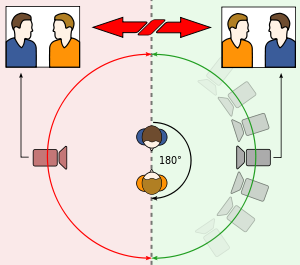
The following picture, describes the 180 degree rule.


The 180 Degree Rule:
The green and red arrowed lines show the line the camera can take around the two subjects in the conversation. Once the camera passes the grey dashed line, the subjects switch places on screen.

The Rule of Thirds:The rule of thirds is a tool to add dynamics to a photo or scene. An imaginary grid is to be considered. Points of attention are created, where the lines overlap, as seen in the above picture. Naturally our attention is drawn to these areas, therefore, items of interest are generally placed in the top or bottom upper and lower codrents of each left and right side.

The Inverted Pyramid


Peace out, touch base again mondayz yo'

oh and check this car out.. complete & utter awesomeness..


OI GUYS... Lets watch a movie/television... (TASK)!!!!!!

Who = Close up shots - Show characters in Detail ect.
Belle and Aiden (Husband) shes got a cancer yo :( sad face. shes dieng, this close up explicates the emotion and sadness of the situation as she tells her husband.


What = Mid Shot - Shows action


Martha gets a shock when she shows Morag around the farm due to Ruby and Xavier's 'presence'


When = Wide Shot (by josh's standard), Close Up - Establishing Time

Showing the BBQ lunch in Tony and Rachel's backyard.. Rachel's baby is still missing, believed kidnapped..! SHOCK HORROR

Where = Long Shot - Shows detail of surrounding area, at the start of a scene, considered a establishing shot.


Summer Bay Surf club, setting the scence with a long shot of the club. Rachel's Child is missing! this sets the scene for where she approaches random people on the beach in a frenzy asking "have you seen this baby?!"


Why = Big Close Up - Demonstrates in greater detail a character and their actions.


Crazed Jane is watching again, alleged kidnapee, "i think my mums gone crrrrraaazzzzy", show her stalking Rachel and Tony.


How = Medium Close Up, a series of Close Ups - Describes events ect.


Belle just wants to float away from her troubles, shes got cancer and is dieing yo'. sad face. :(


Monday, August 10, 2009

Morning Tutorial 10/08/09

YOOO'

heres some picutres:


SICK

now they're cropped..


SICK

Heres a video already on youtube:


SICK

Heres a video i recorded and now have added to the blog:


SICK

Language of the screen definitions:

ECU is an abbreviation in the film and television world for 'extreme close up shot'. Generally, ECU's include extreme detail of a single item, purposely excluding the broader screen.

WS/VLS (very long shot / wide shot) is a shot that incorporates a wide view to observe the entire character, action or general item of intrest.

MS, medium shot, shows about half of the complete subject, the most common shots in movies ect.

Bibliography:
english.unitecnology.ac.nz/resources/units/piano/film_terms.html
http://www2.hawaii.edu/~ricky/etec/glossary.html
http://www.releasing.net/filmmaker/long_medium_close-up_shots.html

Thursday's Lecture 6th/08/09

yooooooooooooooooh'

so didn't get time to post a summary on thursday, but here it is now.

so i rocked up late and we had a new lecturer, who decided to give us a brief 1 hour history into the life of computers ha. From the garage nerds to massive company production of pc's.. it was intresting to say the least.

Here's a timeline!


- Charles Babbage"s 19th century Difference Engine (designed to calculate and print mathematical tables)
- Ada Byron, Lady Lovelace, annotated her own translation of an Italian article about Babbage, Sketch of the Analytical Engine, first conceived of a machine which would be able to compose and play music, produce graphics and be of everyday use. She also conceived the first computer program.
- Alan Turing, wrote a crucial paper clarifying the computability of numbers and the possibility of a machine to compute them, On Computable Numbers.
- Turing worked with teams of mathematicians and cryptographers to devise the first working computer, The Bombe which they used to break secret German "Enigma" codes during the war.
- After the War, Turing investigated programming, neural nets, and the prospects for artificial intelligence.
- Computers were first commercially produced by IBM in the 1950s.
- 1965, Gordom Moore propounded Moore"s law: the capacity of microchip"s doubles every two years.

History of the Internet:

1957:The United States Department of Defense formed a small agency called ARPA (Advanced Research Projects Agency) to develop military science and technology.
1961-1965:The Massachusetts Institute of Technology (MIT) started to research sharing information in small, phone-linked networks.
ARPA is one of their main sponsors.
1966: The first ARPANET plan is unveiled by Larry Roberts of MIT. Packet switching technology is getting off the ground, and small university networks are beginning to be developed.
1969:The Department of Defense commissions the fledgling ARPAnet for network research. The first official network nodes were UCLA, Standford Research Institute,UCSB, and the University of Utah. The first node to node message was sent from UCLA to SRI.
1971: more nodes join the network, bringing the total to 15. These new nodes include Harvard and NASA.
1973: ARPAnet goes global when the the University College of London and Norway's Royal Radar Establishment join up.
1974: Network intercommunication is becoming more sophisticated; data is now transmitted more quickly and efficiently with the design of TCP (Transmission Control Program).
1976: Unix is developed at AT and T; Queen Elizabeth sends out her first email message.
1979: USENET, the mother of all networked discussion groups, is developed.
1982: Internet technology protocols are developed, commonly known as TCP/IP (Transmission Control Protocol and Internet Protocol). This leads to one of the first definitions of an "internet" being a connected set of networks.
1984: Number of hosts is now up to 1000, with more being added every day.
1985: The first registered domain is Symbolics.com.
1987: Number of hosts breaks the 10,000 mark.
1988: First large-scale Internet worm affects thousands of Internet hosts.
1991: Tim Berners-Lee develops the World Wide Web.
1993: The World Wide Web's annual growth is now at a staggering 341,634%.
1994: ARPAnet celebrates 25th anniversary.
1995-1997: RealAudio introduces Internet streaming technology, dial-up systems emerge (America Online, Compuserve), the Internet backbone continues to be strengthened with the addition of MCI, Microsoft and Netscape fight for WWW browser supremacy, and there are now more than 70,000 mailing lists.
1998-present:The Internet continues to experience staggering growth. More people use the Internet to get connected to others, find information, conduct business, and share information than ever before in history.

http://websearch.about.com/od/whatistheinternet/a/historyinternet.htm

But hopefully we are onto a new topic next week.

yew.

Monday, August 3, 2009

Monday, Week 2 - Tutorial - "Convergence"


Technological convergence is the flow of content across different technological systems, inwhich evolve towards performing similar tasks.

alright so the most obvious new convergence technologies would be smart phones:

Of course the mobile phone was originally designed to make phone calls and perform text messages; smart phones are now miniature computers with a wide array of multimedia, entertainment and internet functions.

Gaming Consoles have evolved from purely gaming to internet browsers, music players, DVD players and social networking tools as well.


This is smart yo':
Photo Speakers - This clever device looks like a photo frame, but actually has speakers built in behind the frame... woaaaaah.. clevveerrzzz

Heres some pointless convergence technologies:


Reactable is considered a instantly responsive, visually compelling and socially interactive music-making experience.

USB finger... right...


Suitcase shaped car


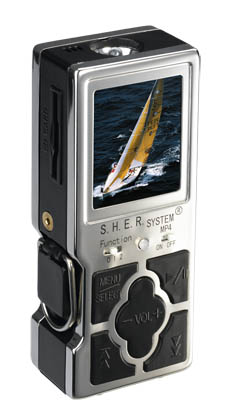
mp4... with breathalyzer and Pest Repellent functions!.. sick what i've always wanted.